Ekurhuleni, South Africa |
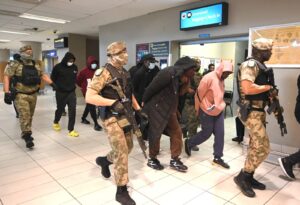
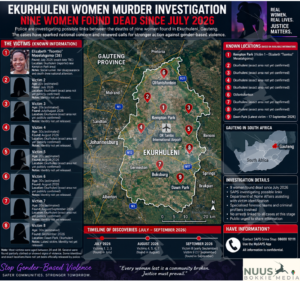
Police in Gauteng are hunting for whoever is responsible for the deaths of eight women whose bodies have been discovered across the Ekurhuleni area since mid-July, after an eighth victim was found behind a nightspot in Kwa-Thema, Springs, on the evening of Tuesday, 15 September 2026. The discoveries, concentrated around Kempton Park, the R21 highway, Olifantsfontein, Clayville and now Kwa-Thema, have triggered a national safety warning for women, an expanded police operation, a R400,000 reward for information and a planned security “lockdown” of the areas involved.
The first body was found on 15 July 2026, when police discovered a 37-year-old woman lying half-naked in an open veld near the R21 highway in Kempton Park. Her body reportedly showed signs of restraint. A suspect was arrested two days later, on 17 July, and has remained in custody since — though police have not said whether that arrest is connected to any of the murders that followed.
Just over a month later, on 24 August 2026, a second body was found close to the same stretch of the R21. The victim, a 32-year-old woman, was also found half-naked and with visible bruising on her body.
The toll rises through September
The pace of discoveries accelerated sharply in September. On 7 September, the body of an unidentified woman, believed to be in her late twenties, was pulled from a river in Clayville, near Tembisa Mall. On 10 September, another unidentified woman’s body — badly decomposed and half-naked — was found near Rhodesfield in Kempton Park; she has still not been identified.
Two days later, on 12 September, police confirmed that a body found in Rhodesfield, behind a local hotel, was that of Elizabeth “Tsontso” Moselakgomo, 38. Moselakgomo, a member of the Team Vitality running community, had left her eight-year-old daughter at home to go for an afternoon jog before she disappeared; she was found wearing her running gear. Her death turned the case from a string of anonymous discoveries into a story with a name, a family and a community left grieving — and sharpened public fear that women out running or walking alone in the area were being targeted.

A fifth body was subsequently found on the R21 closer to Olifantsfontein, taking the toll to five by 14 September, when Gauteng police first confirmed a dedicated task team had been set up. By 15 September, Acting Gauteng Provincial Police Commissioner Major General Fred Kekana confirmed the count had risen to seven, before an eighth woman — found naked and in a state of decomposition behind Club 69 in Kwa-Thema, Springs, that same Tuesday evening — pushed the confirmed toll to eight by the time Acting Police Minister Professor Firoz Cachalia briefed media that night.
According to the Citizen/Rekord’s rundown of the case, published 16 September, the eight bodies have in total been recovered from Kempton Park, Olifantsfontein, Clayville and Kwa-Thema over the roughly two-month span from 15 July to 15 September. Several of the women were found naked or partially clothed, and some had visible bruising or other injuries consistent with violence. A number of the victims remain unidentified.
What police are saying
Cachalia, briefing reporters on Tuesday night after just returning from an official visit to China, said it would be premature to conclude the killings are the work of one person or group. He described the cases at this stage as appearing to be “quite distinct, separate events,” while confirming that a multidisciplinary task team — made up of detectives, crime intelligence officers, forensic specialists and investigative psychologists — has been assembled to establish whether any of the murders are linked.
Despite that caution, the police response has escalated well beyond a routine murder investigation. SAPS has announced it will expand Operation Shanela, its high-visibility policing initiative, into Kempton Park and the surrounding suburbs, and is preparing to effectively “lock down” the area in the coming weeks with a dedicated specialist team. A reward of R400,000 has been offered for information leading to an arrest. National police spokesperson Brigadier Athlenda Mathe has confirmed that safety concerns are no longer being treated as confined to Ekurhuleni alone, extending the warning to women more broadly.
Cachalia said police were determined to “leave no stone unturned” in bringing those responsible to justice, while appealing to communities to share information with investigators rather than speculate or spread rumours on social media.
President Cyril Ramaphosa has since weighed in directly, ordering police to prioritise the investigation and vowing that justice will be done for the victims and their families, as concern over the case spreads beyond Gauteng.
The Kempton Park case has landed against an already grim national backdrop. SAPS’s second-quarter crime statistics for 2026 recorded 569 women murdered between April and June alone, along with more than 1,000 attempted murders of women, even as South Africa’s overall murder rate declined slightly over the same period. Research from the South African Medical Research Council has found that femicide more than halved between 1999 and 2020, though the decline has been uneven across provinces — a reminder that despite the long-term trend, cases like Ekurhuleni’s continue to expose how unsafe many South African women still feel, and are, in public spaces.
Forensic and DNA results from several of the more recent bodies are still outstanding, and police have not ruled a serial killer in or out. Communities in Kempton Park, Rhodesfield, Olifantsfontein, Clayville and Kwa-Thema have been urged to avoid walking or jogging alone, particularly in isolated or poorly lit areas, while the task team continues its work.
This is a developing story and Nuus Bokkie will update it as new information, arrests or official confirmations are released by SAPS.