International | Miami —USA
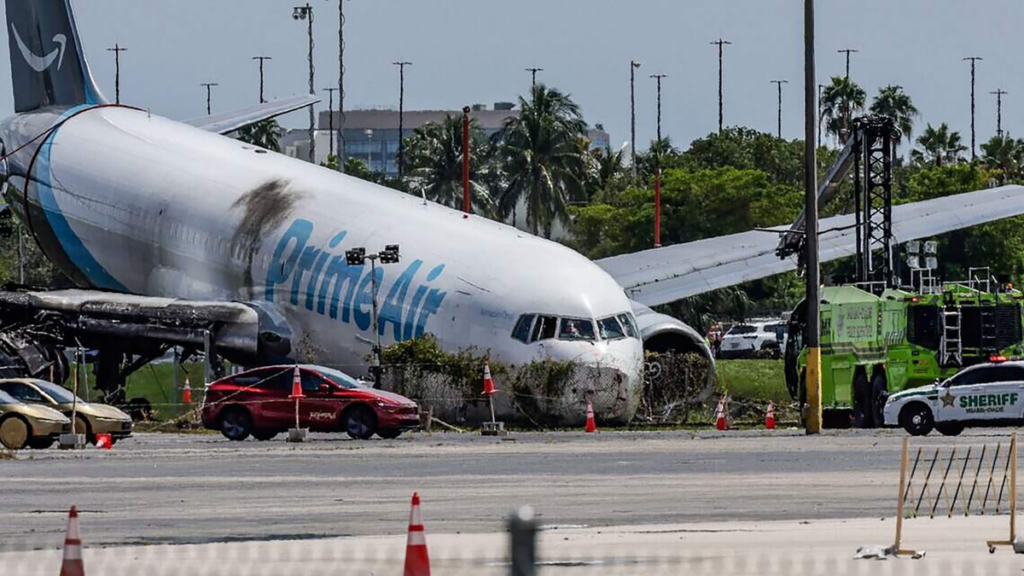
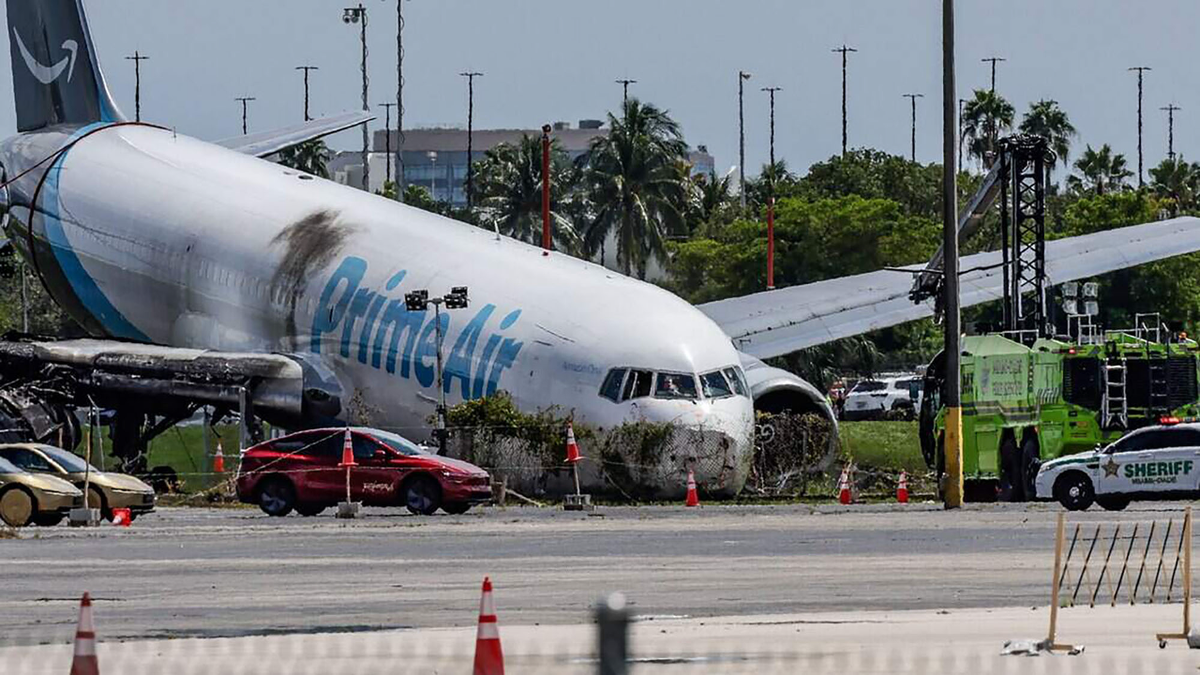
A Boeing 767 cargo aircraft flying for Amazon Air overran the runway while landing at Miami International Airport on Sunday afternoon, ploughing through a perimeter fence and slamming into a crew van and an SUV, killing five people and injuring five others. The National Transportation Safety Board (NTSB) has launched a full investigation and is expected to remain on scene for about a week.
The aircraft, operating as 21 Air Flight 7598, was arriving from Luis Muñoz Marín International Airport in San Juan, Puerto Rico, and attempted to land on Runway 30 at around 2pm local time on Sunday, 6 September. According to the Federal Aviation Administration (FAA), the 767-300 freighter failed to stop within the runway’s more than 9,000-foot length and continued roughly 400 metres (1,300 feet) past the paved surface before coming to rest in a grassed area beside a public road used by airport warehouse workers.
Flight-tracking data reviewed by several US networks shows the aircraft climbed above its normal approach path before dropping back down to realign with the runway, and that it passed through a developing thunderstorm as it came in to land. A change in wind direction during the final approach is believed to have produced a sudden tailwind, according to aviation analyst David Soucie, a former FAA safety inspector. Footage circulating on social media appears to show the left rear landing gear failing to settle fully on the tarmac as the plane touched down.
NTSB lead investigator Chihoon Shin said preliminary data from the flight recorders indicates the crew briefly attempted a go-around — a standard safety manoeuvre in which a pilot aborts a landing and climbs back into the air to try again — before abandoning that attempt and instead applying the brakes and pulling the throttles to idle. Shin said the recorded data show no indication that the plane’s speed brakes or engine thrust reversers were deployed as it sped down the runway. NTSB Chairwoman Jennifer Homendy said investigators want to interview the pilots before releasing further detail from the cockpit voice recorder.
After leaving the runway, the aircraft tore through a chain-link security fence before striking a van used to transport a cleaning crew, killing all five occupants, and then colliding with an SUV on the public roadway. Homendy described the debris field, which included torn fencing, airbags and wreckage from both vehicles and the aircraft, as extensive and devastating. A fire broke out on impact, sending thick black smoke into the air, and Miami-Dade Fire Rescue said more than 60 units responded to find the aircraft engulfed in heavy flames.
Miami-Dade County Sheriff Rosie Cordero-Stutz named the five people who died as Rolando Aleman Leon, 55, Yoel Rodriguez Narajo, 53, and three further victims, all occupants of the cleaning crew van. Of the five people injured, three remained hospitalised as of Tuesday, with two in critical condition — identified as van occupant Ridoel Averhoff Diaz, 32, and Eugenio Corredor, 79, who was in the other vehicle struck — and one in stable condition.
The aircraft’s two pilots, both injured in the crash, were treated and discharged from a Miami hospital by Tuesday morning. They have been identified as Captain Joseph Carroll, 55, who held 7,145 flight hours as of the end of March and received his Boeing 767 type rating in May, and First Officer Jaime Felipe Silva Molina, 37, who had logged 2,655 flight hours and was type-rated on the aircraft in April 2025. Both were scheduled to be interviewed by NTSB investigators on Wednesday, alongside 21 Air’s chief pilot.
The Boeing 767-300 involved was built in 1994 and originally flew as a passenger aircraft for more than two decades before being converted into a freighter in 2015, according to flight-tracking site Flightradar24. It was on its third flight of the day at the time of the crash and was operated by 21 Air LLC, a North Carolina-headquartered cargo carrier with a 24-hour operations centre in Miami. The company is one of nine flight vendors contracted to fly for Amazon Air, which coordinates more than 250 cargo flights daily across its vendor network. According to aviation data firm Cirium, 21 Air operates eight Boeing 767s on Amazon’s behalf.
21 Air chief executive Keith Winters said the company was devastated by the accident and was cooperating fully with investigators. Amazon spokesperson Kelly Nantel said the company’s sympathies remained with the families and loved ones of those affected, and that Amazon was coordinating with 21 Air and supporting the NTSB’s investigation. Boeing also issued a statement extending condolences to the victims’ families and confirming it was assisting the inquiry.
The crash triggered a roughly three-hour ground stop at Miami International Airport, one of the busiest in the United States, over the Labor Day weekend. More than 450 flights in and out of the airport were delayed or cancelled on Sunday night, according to FlightAware. One of the airport’s three runways, closed off for the investigation, was reopened on Tuesday evening once NTSB investigators had finished documenting evidence there, though work continued at the main crash site near the end of Runway 30.
Homendy said runway overrun accidents, known in aviation circles as runway excursions, remain a persistent and recurring problem despite decades of safety recommendations, and that the NTSB’s job is to identify exactly what went wrong this time so it is not repeated. A full final report determining the official cause of the crash and any resulting safety recommendations is not expected for a year or more, though investigators are expected to release further preliminary findings, including details from the cockpit voice recorder, once the pilot interviews are complete.
This is not the first fatal accident involving an Amazon-branded cargo flight. In 2019, an Atlas Air-operated Boeing 767 flying for Amazon crashed into Trinity Bay near Houston, Texas, killing all three people on board, after air traffic controllers lost contact with the aircraft during its descent.