Pretoria, South Africa | The Madlanga Commission of Inquiry has for the first time publicly released photographs identifying the alleged leadership of the so-called “Big Five” cartel, the shadowy Gauteng-based criminal syndicate that investigators say has spent years infiltrating South Africa’s police service, prosecuting authorities and political establishment through drug trafficking, tender fraud, hijackings and contract killings.
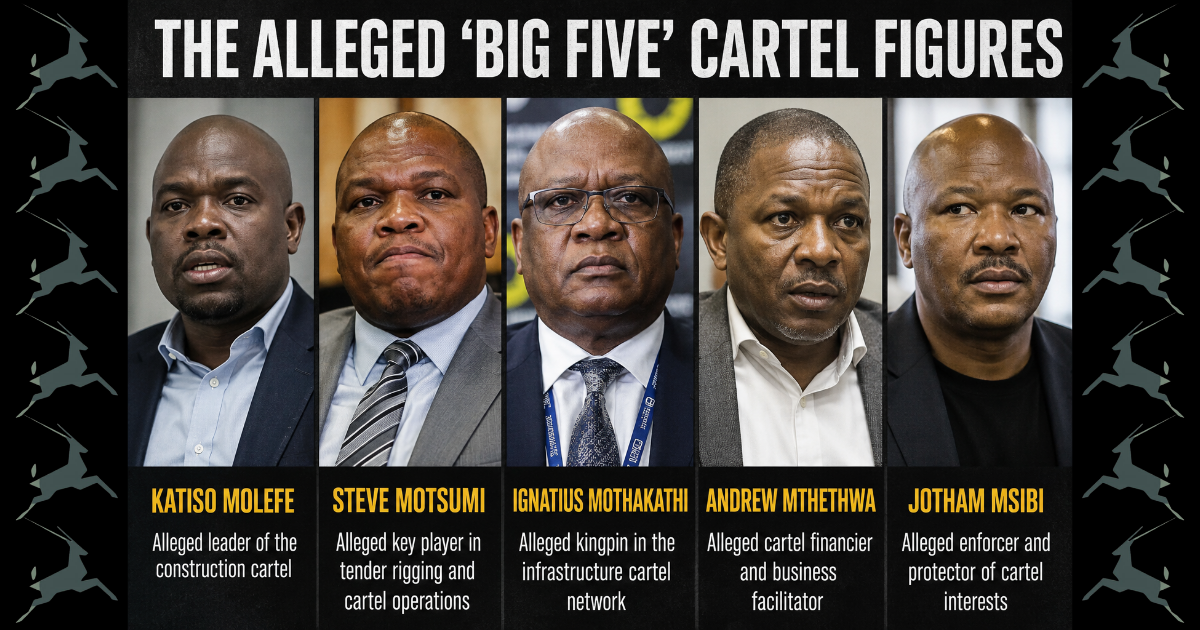
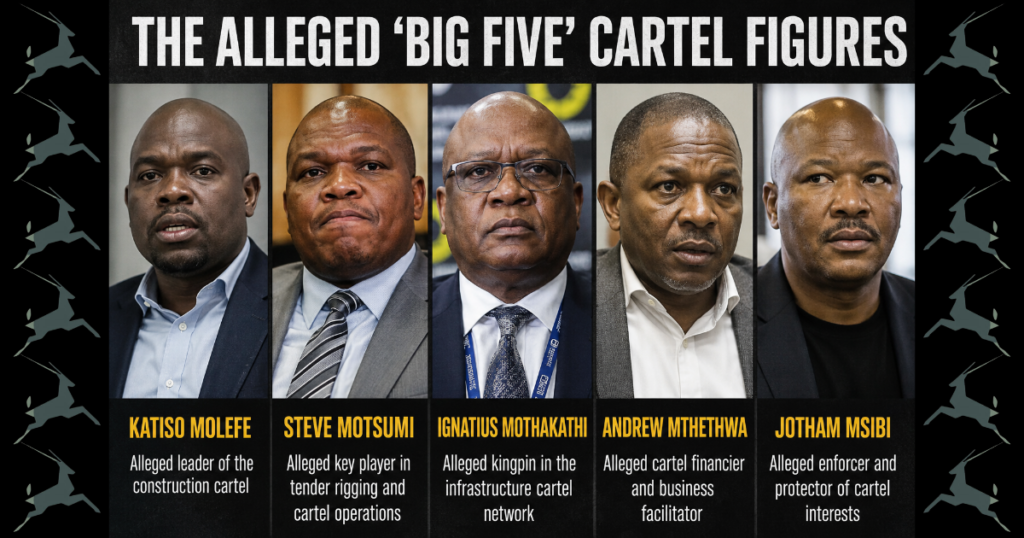
Eyewitness News shared the image on X on Wednesday, 2 September 2026, naming the five men pictured, left to right, as Katiso “KT” Molefe, Steve Motsumi, Ignatius Pheello Mothakathi, Andrew “Boy” Mthethwa — also known in cartel circles as “King Nyambose” — and the late taxi boss Jotham “King Mswazi” Msibi, shown in a white shirt. The photograph, understood to have been taken on 21 June 2022, was put before the commission during the concluding testimony of retired Hawks national head Lieutenant-General Godfrey Lebeya, as evidence leaders pressed him on how much he knew about the syndicate and its members.
The Big Five’s existence first entered the public record on 29 September 2025, when then-Crime Intelligence boss Lieutenant-General Dumisani Khumalo told the commission that a “sophisticated” organised crime syndicate based in Gauteng was operating across drug trafficking, hijackings, tender fraud and contract killings, and had “already penetrated the political sphere.” Khumalo testified that the network had a core leadership of five kingpins, supported by smaller specialist syndicates handling individual crimes, and said senior politicians were “alleged to be complicit and/or wilfully blind to the syndicate’s operations.” At the time, Khumalo named only two figures publicly — tenderpreneur Vusimuzi “Cat” Matlala and Katiso “KT” Molefe — while placing both towards the lower end of the network’s hierarchy, suggesting more dangerous figures sat above them. A month later, in-camera testimony from a protected witness known only as “Witness B” went further, describing the cartel’s internal hierarchy and naming Msibi as its “president.”
Of the five men now publicly identified, Molefe carries the heaviest legal exposure. He is facing trial on more than 30 murder charges, including in connection with the 2022 killing of DJ Sumbody, whose real name was Oupa Sefoka, and the 2024 murder of engineer Armand Swart, alongside allegations of state tender manipulation. Molefe was controversially granted bail in October 2025 amid media reports of an alleged R2.5-million bribe paid to court officials to secure his release. Msibi, regarded by investigators as the group’s leader, has since died; Matlala has separately testified that he regarded Msibi almost as a father figure and that Msibi, in turn, treated him “like a son.”
The commission has heard extensive testimony about how the network allegedly reached directly into the Hawks’ own operations. On 6 December 2024, the Political Killings Task Team (PKTT) arrested Molefe at his Sandhurst home in connection with the Swart murder. That same day, Lebeya received a call from a socialite known as Malcolm X, who alerted him that people at Molefe’s house may have been impersonating Hawks officers. Lebeya told the commission he dispatched officers purely to verify the claim, not to interfere with the arrest. But a WhatsApp message from Malcolm X to Lebeya, read into the record, thanked the then-Hawks boss for sending officers to the scene and added that “King Nyambose really appreciates all your efforts, general” — a reference, the commission’s photographs later confirmed, to Andrew Mthethwa. Lebeya maintained he did not know who “King Nyambose” was and had never met Mthethwa, prompting Commissioner Advocate Sesi Baloyi to note pointedly that “there have been generals that have come here before the commission who have been afraid to mention some of these individuals.” Evidence leader Advocate Lee Segeels-Ncube separately challenged Lebeya over how he could verify Malcolm X’s account when Malcolm X was, at the time, himself the subject of a Hawks investigation.
Other names have surfaced around the core five as the commission’s evidence has widened. Sergeant Fannie Nkosi, a police officer, has been described in testimony as an alleged information and kickback conduit between the syndicate and SAPS, allegedly feeding Mothakathi real-time details about the arrest of a suspected hitman linked to the group in exchange for payment. Businessman Ze Nxumalo has also appeared in commission photographs alongside members of the network, while Brown Mogotsi — an associate separately linked to Matlala and to suspended Police Minister Senzo Mchunu — has been named in Wikipedia’s public record of the syndicate’s notable associates. In August 2026, the commission heard further evidence that Msibi, Motsumi, Molefe and Sergeant Nkosi had discussed plans to sell illegal “grabber” cellphone interception technology to authorities in eSwatini, and separately probed an alleged R360-million police procurement deal connected to interception equipment.
The Big Five’s alleged reach into politics was first raised publicly in July 2025, when KwaZulu-Natal police commissioner Lieutenant-General Nhlanhla Mkhwanazi held an explosive press briefing accusing then-Police Minister Senzo Mchunu of interfering with investigations into the syndicate and of ordering the disbandment of the PKTT — the same unit that had arrested Molefe. Mkhwanazi further alleged that Matlala was financially backing the political ambitions of both Mchunu and Mogotsi. Those claims prompted President Cyril Ramaphosa to establish the Madlanga Commission, chaired by retired Justice Mbuyiseli Madlanga, which began public hearings on 17 September 2025 with testimony from Mkhwanazi and then-national police commissioner General Fannie Masemola.
Since then, the commission has heard evidence describing the syndicate’s alleged reach into cocaine trafficking as well, including a shipment routed from Brazil through Durban to Gauteng in which R55 million was allegedly compromised at the scene and later went unaccounted for, and a separate R300-million cocaine bust in Aeroton, Johannesburg, both of which investigators have linked to the same trafficking pattern and suspected insiders within the ports and police.
Lebeya, who denied all knowledge of the Big Five cartel and said he doubted it was even “registered as an organised crime project,” concluded his testimony this week. His denials were tested against earlier evidence from Major-General Lesetja Senona, the former KwaZulu-Natal Hawks head who has separately testified extensively about his own ties to Matlala, and from Khumalo, both of whom have described some individuals linked to the syndicate as “dangerous.” The commission’s evidence leaders have made clear that Lebeya’s account will be weighed against the mounting web of testimony — spanning Matlala’s own evidence on tender manipulation and police payments, Senona’s admissions about leaked SAPS documents, and now the public unmasking of the alleged Big Five leadership — as the inquiry continues to map the scale of alleged criminal infiltration of the state.
Nuus Bokkie will continue to track developments as the Madlanga Commission’s investigation into the “Big Five” cartel continues.