International | Iran — USA
Iran unleashed its biggest wave of retaliatory attacks since its war with the United States began, striking a key American air base in Jordan and hitting ten ships near the Strait of Hormuz on Wednesday, after US forces destroyed five Iranian oil tankers a day earlier. At least one seafarer has been confirmed dead and another is missing, and global oil prices have surged past $100 a barrel for the first time since July.
The escalation marks the most extensive exchange of attacks on military and commercial targets since the six-month-old conflict erupted on 28 February 2026, and comes amid growing fears that the confrontation between Washington and Tehran is entering a far more dangerous phase.
The latest round of hostilities was triggered on Tuesday, 8 September 2026, when US Central Command (CENTCOM) forces struck and destroyed five Iranian crude oil carriers after Iran’s Islamic Revolutionary Guard Corps (IRGC) twice targeted a US Navy warship with ballistic missiles over the preceding two days. The warship successfully evaded both attacks and no American personnel were injured, CENTCOM confirmed.
The five vessels destroyed were named as the M/T Charminar, M/T Kaviz, M/T Riesco and M/T Horizon 1, all struck in the Gulf of Oman, and the M/T Derya, hit near Kharg Island — Iran’s main oil export hub, which handles roughly 90 percent of the country’s crude exports. The US military released video footage showing the tankers ablaze before sinking.
US Secretary of State Marco Rubio, speaking during a visit to Colombia, confirmed that Washington has now struck ten Iranian tankers in total over the past week alone. “Iran continues to try to hit US naval ships, and for every time they do that or try to do that, they’re going to lose tankers,” Rubio said.
Iran’s response came overnight into Wednesday, 9 September, when its Revolutionary Guards fired a barrage of ballistic missiles at Muwaffaq Salti Air Base (MSAB) in eastern Jordan, a critical hub for US airpower operations against Iran that hosts dozens of American warplanes.
Jordanian officials said 18 incoming missiles were intercepted, while two landed in unpopulated areas. US forces fired more than 30 Patriot interceptors during the attack. Both American and Jordanian officials confirmed no US personnel were killed in the strike, though the base has been targeted before — three US Army soldiers were killed in a missile attack on MSAB in July 2026.
Despite the interceptions, Iran was able to inflict material damage. People familiar with the matter told Air & Space Forces Magazine, in reporting first surfaced by CBS News, that one A-10 Thunderbolt II attack aircraft — commonly known as the “Warthog” — suffered a severely damaged wing in the strike, while approximately eight F-15E Strike Eagle fighter jets sustained lighter damage. The F-15s have since returned to service. Iran’s IRGC publicly claimed credit for damaging the American aircraft in the hours following the attack.
The A-10, originally designed for close air support against ground targets and one of the US Air Force’s oldest and most recognisable aircraft, has played a prominent role in the Iran campaign, hunting Iranian fast-attack boats in the Strait of Hormuz. The aircraft had been slated for retirement by the Air Force before the war began, but Secretary of the Air Force Troy Meink recently confirmed the fleet will now remain in service until at least 2030.
Iran claims strikes on 10 vessels near Hormuz
Simultaneously, Iran’s Revolutionary Guards said they had targeted ten ships attempting to pass through an area near the Strait of Hormuz that Tehran has declared off-limits — describing the targets as two US vessels and eight oil tankers, which state media also referred to collectively as “non-compliant vessels.”
The human cost of the shipping war became apparent when the oil products tanker Hercules Star was struck while at anchorage off Dubai. The vessel’s charterer, Peninsula, confirmed that one seafarer was killed and another crew member is missing. Maritime security sources said the tanker may have been hit by a drone. Britain’s maritime security agency, UKMTO, separately reported a vessel in the vicinity listing and possibly taking on water after being struck by a projectile, though it was not immediately confirmed whether this referred to the same ship.
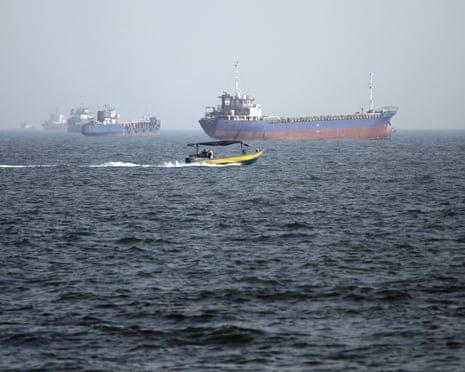
The Revolutionary Guards warned they would sharply escalate further, threatening to strike 20 targets for every two or three attacks against Iranian interests, and said they would soon release maps of a newly enlarged exclusion zone at sea stretching as far as Chabahar on Iran’s southeastern coast.
Oil prices surge, shipping grinds to a near-standstill.
The dual attacks sent energy markets sharply higher, with benchmark Brent crude futures breaching $100 a barrel for the first time since July as traders weighed the risk of a prolonged disruption to one of the world’s most critical oil chokepoints. Commercial shipping through the Strait of Hormuz — through which roughly a fifth of global oil supply normally passes — remained at a near-standstill through the week as a result of the renewed hostilities.
The tit-for-tat attacks have shattered a month of relative calm that had held since late August, with both the US and Iran now striking military, shipping and energy assets in quick succession. Analysts warn the exchange signals a further widening of a war that began in February and shows no sign of a swift resolution.